On the days when my son Briggs is with me, we do it together. On days like today, when he’s with his dad, I typically text them how many tries it took me to solve it, and then they tell me the same.
His dad and I are divorced, but the three of us are still (and always) a family.
The Wordle play is both connective and playfully competitive.
Truth: Briggs and his dad typically solve Wordle in fewer tries than I do. I usually credit them with being better at puzzles. It’s 100% all in fun, and none of us are engaged in any kind of “who’s smarter than who” competition… though our son is a teenager, so by default, he knows everything. 😉
I had a bit of a revelation during my solo Wordle match yesterday.
I was approaching my third guess. I already knew four of the five letters: I, E, L, and T, and I knew that the T was at the end. Even though I had all this information, my brain couldn’t unsee the word “FIELD”—even though I knew that couldn’t be right.
After getting stuck on “FIELD” for what felt far too long, all I could hear were words that rhymed with “FIELD”—none of which could be the solution.
I was in a loop…until…I allowed myself to play with an answer I knew wasn’t “it.”
I submitted F-I-E-L-D and saw all the letters, except for the D, signal that I was getting closer.
Suddenly, “FILET” became visible, and I solved it in four.
It feels almost silly, but up until yesterday, I was approaching the game as a race to win with the fewest guesses. Now, I don’t think that’s the point whatsoever.
I think the object of the game is to show me how to shift my thinking, recognize when loops are hurting or not helping, and remember that not every attempt is about getting it right but rather about getting new information.
The summer following my sophomore year of high school, my grandfather and his wife, Margaret, drove my sister, Lindsey, and me down and up the Atlantic coast.
By then, my mom and dad had been divorced almost as long as they’d been married. My dad had decided to move to Florida, and with that decision came a year without being able to see or be near him.
Yes, of course, there were issues—like a lot of them—but my memory tells me that his moving away at that point in my life ended up giving me a hole. The kind that makes room for eternal missing—no matter what.
When my mom’s parents decided to rent a travel van and make the (very) long ride from New Hampshire (where we all lived) to Florida and then back to their summer home in Maine, they also generously offered to take Lindsey and me along for the whole trip.
To this day, I have no clue if they asked my mom before they asked what I thought about going. I remember crying for all the reasons.
I missed my dad. Immensely. I’d also just had my heart broken for the very first time, and my ex started dating my former best friend. Any place, even a somewhat cramped conversion van with my grandparents, sounded better than sticking around town and feeding my feelings with Prince Mac & Cheese and Dazed and Confused on rewind.
I do, however, remember what my mom said to me right before I got into that van:
“Be good. You’ll go out to eat a lot, remember you don’t need to order a drink every time. And when you get to Maine, you and your sister are NOT allowed to ride in the car if Heather’s driving.”
Heather was Margaret’s youngest daughter. She was only a few years older than me and had recently been given a sports car. Everyone knew she wasn’t the best driver; it was a small town and an even smaller family.
I told my mom I loved her; she said she loved me and was serious about Heather.
I said, “I know.”
There’s a lot of story between that goodbye and our first Saturday morning in Maine when Lindsey and I made our way into Heather’s little two-door red car despite my (and my grandparents’) awareness of my mother’s seriousness. But this is the story of the crash and the hole.
Because obviously, we crashed.
For me, the worst part wasn’t the ambulance ride, the loud sounds, the crowd that gathered, or all the glass and blood. For most of my childhood and pre-driving teen years, I aggressively insisted that I ride shotgun because I was the oldest.
But Heather was older than me (and the younger sister in her own family), so I slumped in the back when she insisted Lindsey ride shotgun. My head hit hard on the side of the car. Lindsey’s spidered the windshield.
When Lindsey leaned back and looked at me stunned and spotted with glass and blood all over her forehead and cheeks, I instinctively hugged her into my chest and said, “It’s okay. You’re okay. You’re okay. It’s okay.”
(Many years later, Lindsey told me even though she knew I reached for her out of love and concern when I pulled her close, she felt the little shards of glass go deeper into her forehead.)
Ultimately, no one involved was seriously physically injured. Everyone did go to the hospital, but everyone also left the hospital that day unassisted and without a cast.
But, there was damage.
The call to my mom (even though I didn’t make it) hurt, and so did her arrival the next day. My mom’s and Lindsey’s and my relationship with that entire side of the family was never the same after that.
That really hurt. Then, less. Occasionally, it would hurt all over again for reasons that did and didn’t make sense. Then, not so much.
For me, they fell into that hole of missing, and while multiple (and good) attempts were made (by everyone), we just never all got out.
It’s unfair, but in this case, my grandparents’ kind and good intention of filling one hole made another.
Most nights, when my son is at my house, we play between one to three “street pickleball” games before dinner. We live in a lovingly congested neighborhood where kids, pets, and adults still make space for one another.
We don’t set up a net; our equipment came from Dollar Tree, but we both get pretty into it. Zara likes to watch from the living room’s big picture window, and more than once, we’ve given neighbors, dog walkers, and other passer-byers a fairly decent show.
A few weeks ago, after Briggs started a pickleball unit in gym class, we asked the kids next door for a piece of chalk to outline an “official” court. They obliged, and Briggs and I confirmed the dimensions with old man Google, mapped them out with the appropriate number of steps, and put the chalk to the pavement.
Then we played.
I won that best-of-three series, but neither of us got our typical dopamine rush from going after long shot balls (which on an official court were 100% out) or sprinting after the tiniest pop of a return (which absolutely would not make it over a net).
On our way into the house, I told him:
“Even though I’ll take the W, I think I like it better when we just guess on the boundaries and don’t play on an actual court.”
He responded:
“I would rather take the W, but you’re not wrong.”
The next time we played, Briggs mentioned that he learned in gym class that scoring only happens when you serve, so we decided to apply that official rule and return to eyeballing the boundaries.
This time, the game time doubled (which we loved), and the dopamine rush returned (which we really loved).
By the end, we were both sweaty, happy, and satisfied—Briggs because he earned the W, and I was struck by the benefits of changing, bending, and even abandoning the rules.
At other times in my life, I can imagine myself experiencing this moment and taking it as a sign from the universe to break the chalk, eff the boundaries, and have more fun doing most (if not all) things the way I want.
I think time changes things, mainly how I think.
Because this time, the lesson felt far more specific:
Pay attention. Know when you’re playing street pickleball with the human you grew, and the goal is staying connected now that he’s out here living. Know when the rules don’t matter. Know when the game isn’t what you’re playing. And know when they do, and it is.
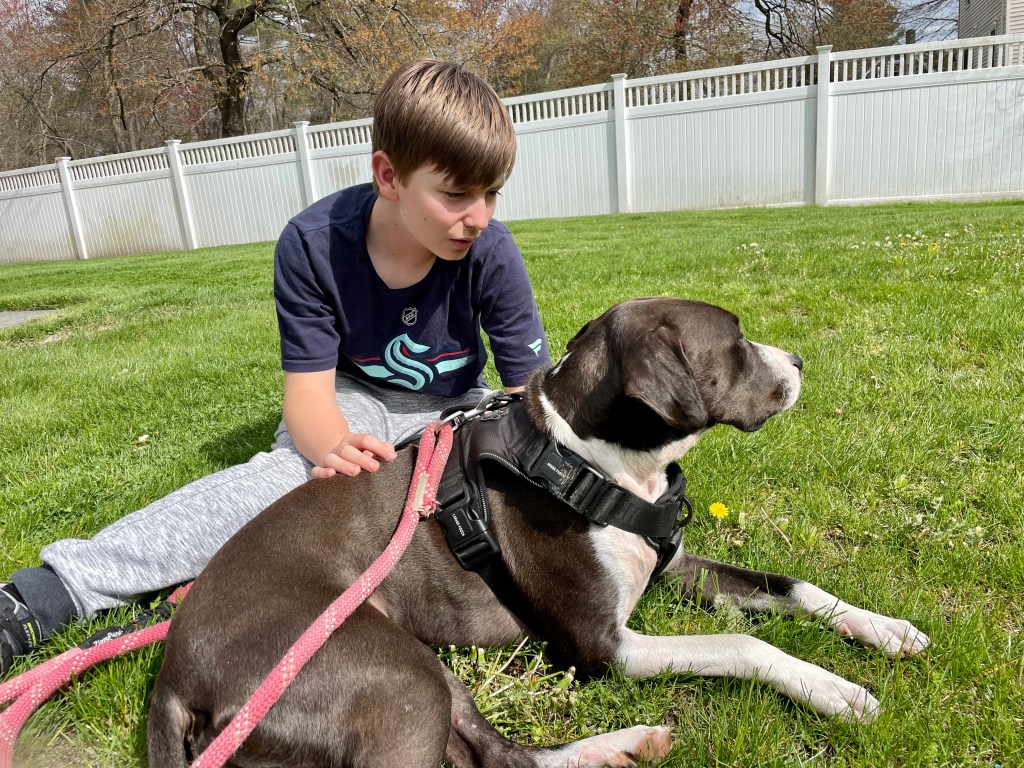
Zara is my rescue pittie. On December 17, 2022, after a very long transport from Texas, I picked her up in Rhode Island. She was six months old, scared, dirty, and a complete love.
From that day forward, Zara has always slept with me…until last week, when she started spending at least half of the night sleeping with my son, and last night when she decided in full to sleep in his bed, even though he wasn’t here.
Now, a few things have changed since Zara’s arrival:
About six months ago, Zara was diagnosed with an auto-immune disease, MMM. The way I understand it, her immune system attacks the muscles in her face and head like an infection.
The good news is that we caught this remarkably early, and the treatment continues to work.
The heavier news is that treatment is a steroid, and while it’s helped in the most important ways, it’s also impacted her disposition and routine.
When Zara first arrived, she was known in the neighborhood as the great empathy dog. Regardless of size or shape, she’d lay down, roll over, and make everyone feel pretty loved when another dog approached.
Now, not so much.
If she didn’t know the pup before her treatment, she’s suspect of them now. Also, felines and any dog the size of one have secured spots on the no-pass list. Thankfully, she’s retained her love of her closest human and canine companions.
Supporting her dispositional changes has included changing her diet, upping her activity, swapping out different collars and leashes, and strategically planning low-trigger outings around the block.
Oh, and I also changed bedrooms.
Around the time of Zara’s diagnosis, I moved my bedroom from a more spacious room upstairs to a tiny room downstairs – this move was due to laundry—which is a story for another post.
Zara was never all-in with the move. She still slept with me but stopped leaping on the bed each night. But it’s what I needed to figure out my laundry issue. So, despite her not loving it, I stuck with the little cramped room for sleeping.
Briggs happily settled into the larger vacated space; apparently, Zara has too.
I am not all in with Zara’s decision to return to her original sleeping quarters—especially given that they are no longer mine.
Though, as she happily trotted down to greet me for our 5:30 morning walk, I couldn’t help but feel that maybe this, too, was love:
Giving myself enough permission and grace to make a change and then doing the same for others—even when their changes don’t entirely suit me.
I don’t want to give the wrong idea, though – plenty of snuggles remain.
When I was 20, I went to Luxembourg through my college’s study abroad program. While there, a friend from school and I decided to spend spring break in Barcelona. On that trip, I got mugged and then pick-pocketed on the train ride home.
When I called my mom from the French railways—through the US Embassy—for the second time in less than twenty-four hours because I’d been robbed—her first question was: “Did you really get pickpocketed, or are you just too embarrassed that you lost your wallet again?”
Not a great moment for either of us.
Twenty-three years later, I understand my mom’s reaction a bit better.
The only thing worse than having ADHD is living with someone who has ADHD. I kid, though, it’s funny because it’s true.
Neither my mom nor I knew I had ADHD growing up, and I only have a diagnosis now because I advocated for my kiddo to be evaluated at a young age. Turns out he got it from his momma.
I grew up losing everything: backpacks, sweatshirts, shoes, and expensive sporting equipment. Once (this demonstrates how small a town I grew up in), my mom gave me a signed blank check to bring to school so I could put down a deposit on my high school class ring. I took the check off the kitchen table and went to school. That night, the phone rang. My mom answered and thanked the person on the other end over and over.
“Amanda?!?!”
“Yeah?”
“Did you put the deposit down on your ring today?”
“Oh shoot, I forgot – but I took the check. They’ll be there tomorrow.”
“Where’s the check?”
“I don’t know, probably in my car.”
“Actually, it’s not because someone from the church recognized my name and just called. When she went to pick up her kid, she found the check lying in the school’s parking lot.”
“Wow, super lucky she didn’t use it.”
“AMANDA!”
Charming and sickening versions of this story exist for every stage of my life.
I mean, case and point, I can recall these exact conversations more than 20 years later, but just this morning, I lost my phone because I made my bed.
Not that anyone saw, but I’m assuming the visual of me barking at Alexa to keep calling my phone and my twelve-year-old using his good ears to find the buzz was the stuff of bad sitcoms.
After successfully uncovering the phone from under a comforter and quilt, Briggs said, “Am I good or what?”
I told him he was the best, and I meant it.
My ADHD rage quickly morphed into a rush of dopamine. And it felt very real to me that even though some things don’t change, they do.
As soon as I wrote that second to last sentence, Tom Sawyer started playing in my head.
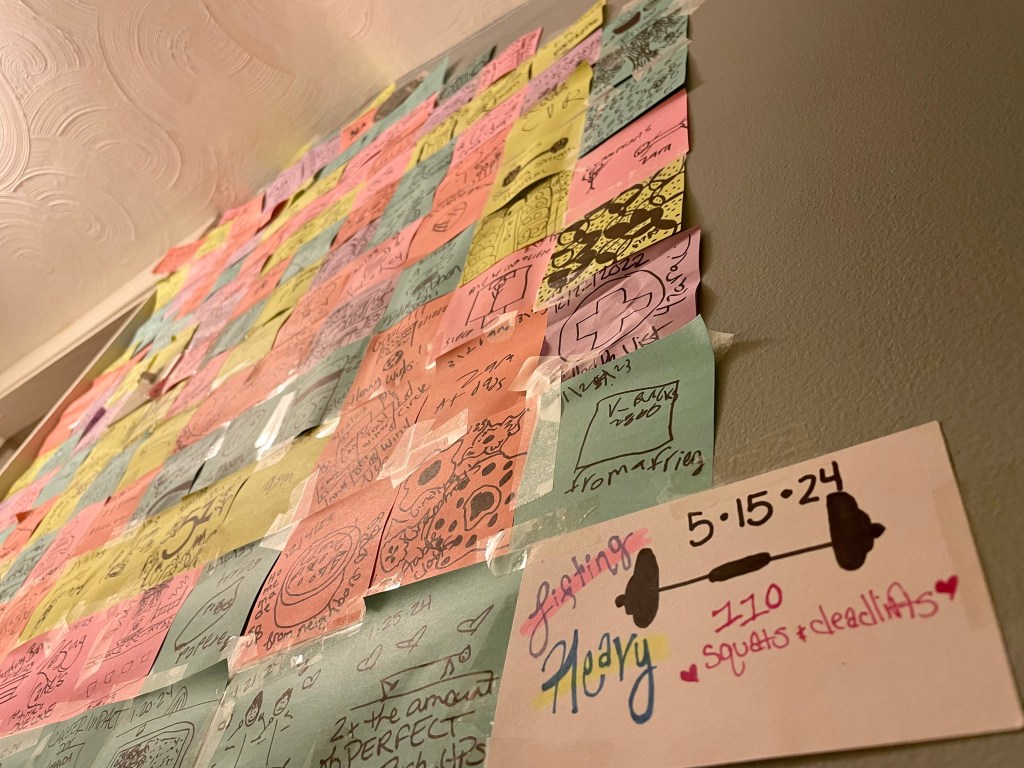
I started a Joy-it wall a few years ago—my one-of-a-kind in-house, low-cost art installation.
The concept = very simple:
Doodles of things that brought me authentic joy.
The resources = also simple:
Post-its.
Sharpies.
Thirty seconds to 10 minutes.
The commitment = simple to understand, not so easy to keep:
One doodle at the end of every day. Also, invite the kiddo to contribute his doodle as often as possible.
Two Rules:
Date doodle
Once doodle is done, stick it on the stairwell wall leading up to our home’s only two bedrooms.
As with most things, I started strong (and to my surprise, the kiddo willfully participated for about the first month). The top left-hand corner of our stairwell, right outside my bedroom door, started to become filled with brightly colored post-its covered in cartoon-esque images depicting dancing in the kitchen, epic video game battles, Christmas tree decorating, lighting incense, having no homework, the arrival of Zara Dew (our rescue pup), fancy dinners, simple dinners, solid sleeps, and so on.
The stairwell received new consecutive pieces for a good two to three months. Then, life, ADHD, boredom, lack of drive, and other new things settled in. So, the doodles took a hard time out. To be clear, they didn’t come down; we just stopped making new ones.
Then, on a particularly rough day, when I very much did not feel like I had the energy to venture from my bed to the basement to rerun a load of wet laundry that had been sitting in the washing machine for too many days to count (no exaggeration), I mustered the strength to get from the bed to the stairwell. And there I lingered.
I stayed stuck on the doodle of the incense. I realized that in addition to not remembering when I started the load of laundry that needed to be rerun, I also couldn’t remember the last time I burned incense.
But I love incense.
I then made a deal with myself that if I reran the laundry, I could reward myself with an unscheduled field trip to Dollar Tree for the grand purchase of three boxes of incense.
That day, all the laundry got done (like washed, dried, folded, put away, done). Incense was burned, and the doodles even returned for a stint.
Today, I discovered that for the first time in a long time, I’m out of incense and post-its. And still, I got the urge to reboot the Joy-it wall, so I did—with a notecard.
I’m finding that even though it’s never the same, it’s okay (even good) to go back and begin again.
Perhaps I’m being slightly generous with in-house art installation. 🙂
My mom stayed at my place on and off a few summers ago.
One day, when she arrived, I didn’t really have time to talk, as I was working from home and helping manage 40 New England-based early education centers. So, she flashed me a handwritten note while I worked through back-to-back calls:
I brought tomatoes from the garden. I’ll make us tomato sandwiches and salad for lunch. Ok?
I gave her a thumbs up.
Hours later, I emerged from the office and found a lovely plated lunch of tomato two ways. My mom was sitting outside in my hammock reading a book. I called to her from the kitchen window:
“Thank you so much. Did you already eat?”
She came rushing in, shaking her head.
“Are you done for the day?” she asked.
“No, but I have twenty minutes when I don’t need to be on a call.”
“Great, I waited to make my lunch to chat while you ate.”
Then, I saw her reach for the remainder of the garden tomatoes. Two of which I knew from growing up with the garden were probably 100% fine but looked super funky. I brought my attention back to my plate, which was clearly made with only the finest and ripest-looking bounty.
I cried a little.
“Mum, you’re still giving me the good tomato.”
She looked a little confused.
At this point, I was 40, and my son had just turned 10. I was remarkably aware of how many times, as a mom, I gave him the first bite, the last bite, the good piece, the best color, or the favorite flavor of anything…of everything.
So much time had passed, and my mom had so many more kiddos (I’m the first of her four daughters), and still, here she was, instinctually, habitably giving me the first, the good, and the best.
Knowing I’m on the receiving end of unconditional Mum-love really does make everything better.
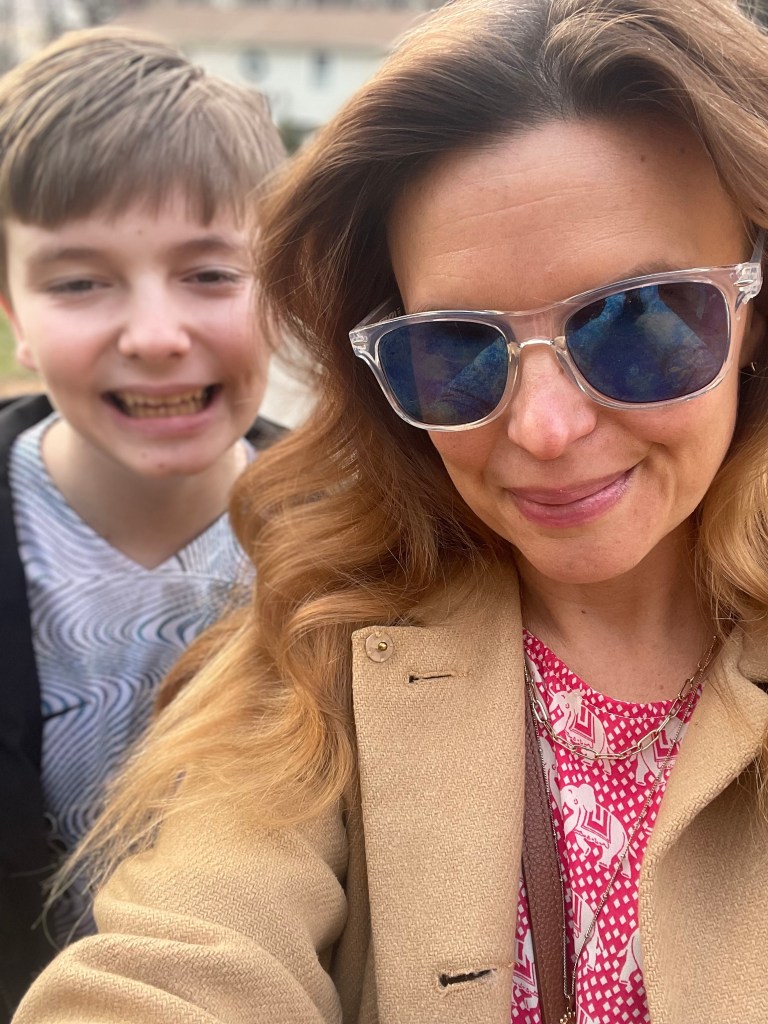
This is Briggs and me a few days before actual Christmas, when we took my Mom, “Omi” out for what will now be our traditional “First Christmas” – a dinner out in late December with Omi’s first-borns (first daughter and first grandson – my Mom only has daughters and grandsons. :))
I have this memory–either from grade school or grad school (honestly, I can’t remember) of a teacher/professor/instructor telling me that most writers avoid second-person narration.
First-person = I
Second-person = you
Third-person = omniscient/all-knowing/god
Now, the other day, on a walk with my rescue pit, Zara, at 5:30 in the morning, before coffee, but after brushing my teeth, remembering poop bags, lacing up my sneakers, and starting the coffee maker so that the water dressed in brown would be ready for me upon our return–I remembered that I did not make my bed.
And then I remembered that book, or graduation speech, or graduation speech turned book, by a retired armed serviceman (I think Naval officer, but I’m doing my best to write this without doing so much research) about the importance of making your bed—starting your day with an accomplishment. The tactical and practical approach stuck with me.
Some posts about my checkered relationship with bedmaking are buried in this blog. I resisted it for most of my childhood and early adult years–then became an evangelist for it for the better part of my thirties and early forties (much thanks to that speech/book and its reinforcement in a podcast called Last 8% Morning that I also followed religiously during the height of the COVID pandemic).
On this particular walk, my neurodivergent brain leaped from the lecture regarding the rare use of second-person narration to that speech or book about the significance of bedmaking to my recall of not actually making my bed that morning. Then, I refocused on Zara and did my best to pay attention during our limited and essential outside morning together time before heading back in and launching phase two: getting the two-legged kiddo (Briggs) to school (fed and groomed) on time.
In between gentle (and not so gentle) instructions to get dressed, brush teeth, use deodorant, and grab the soft pretzel requested for his first meal of the day (all while prepping Zara’s food, water, and meds), I said (out loud): “That’s bullshit, almost every self-help book I’ve ever read is at least partially written in second-person.”
By this time, Briggs was already in the car. As I entered the driver’s seat with my travel mug full of homemade coffee with perfectly frothed coconut-almond creamer, I told Briggs, “It’s only six forty-five, and I’ve already completed more than a dozen tasks.”
He said, “Okay.”
“I can make my bed when I get back. I don’t need to have that one task be the first I complete every morning for it to count.”
Briggs chose not to engage. 🙂
After dropping him off, making the ride home, taking a shower, getting dressed, checking my calendar, and sending a few emails, I went back into my room and took two minutes to make my bed.
From the time I started consuming self-help material, I intellectually knew that none of the instructions or directions were vetted or guaranteed–but I’m confident I lacked the emotional intelligence (or courage) to reframe all second-voice material (Make your bed. Go outside. Take a walk. Mediate. Avoid sugar and carbohydrates. Limit inflammatory foods.) as best-intended first-person offerings:
I make my bed every morning. It helps me set up my day and realize accomplishments. You could try.
I spend a lot of time outside. It helps me feel calm and centered. You could try.
I walk a lot. It helps me feel really good in my body. You could try.
And on and on.
Most days, I make my bed, and I’ve noticed that I tend to feel better on those days. I also really love walking into my bedroom and seeing a made bed. For me, it’s validation that I’ve got some things together; that feels especially important when many other things are coming undone.
Currently, I don’t have any space or interest in taking or giving advice, but I’m infinitely interested in learning more about what is and isn’t working for you and maybe sharing a bit of the same from my point of view.
Up until earlier this week, I had a pot of moldy chili on my stove. Lately, days tend to get lumped together. I didn’t intend to leave the chili pot on the stove. I certainly didn’t mean to ignore the pot long enough for its contents to crust over, but that is exactly what I did.
In truth, I forgot about it. The piss-ant in me wants to call that impressive. That I could actually forget about the huge, orange, covered cast iron pot bigger than my head sitting in plain sight on my stove. Though, it’s only funny because it’s true. I stopped seeing that pot because I didn’t want to deal with what was inside.
Ignoring it was so much easier than dealing with it. Until it wasn’t.
My first thought, upon accepting the pot’s lingering existence, was: toss it out.
One easy trip to the curb on trash day. Done and gone.
Though, with the entire planet currently so sick and diseased, I then thought: adding another thing to the landfill due to nothing more than my complete lack of motivation and commitment is too selfish…even for me.
The Earth has enough going wrong. She doesn’t need my moldy chili pot fueling her sustained dumpster fire.
So, despite my weak stomach and sensitive gag reflex, I took care of the pot. Restored it to full, clean use.
Now, I’m reminded to go about the business of cleaning out the rest of my pots…including those that aren’t nearly as tangible or practical.
Currently, my metaphorical kitchen is stacked with moldy chili pots and staying focused on one at a time still feels pretty damn daunting.
On my 21-st birthday, I was living in Connecticut, going to college, and looking for an apartment.
Financially, itkind of made better sense to live off campus. It would mean that I would have some overages in scholarships and come graduation, my university wouldowe me a check. (That was actually pretty sweet.)
Also, I wanted to play house with a boy I was moving up from Georgia. Socially, emotionally, andtruly financially, this made no good sense at all. (It was actually pretty stupid.)
So, instead of throwing down mugs of green beer (my birthday is on St. Patrick’s Day) or getting another bad tattoo in a questionable spot in Bridgeport, I spent the day going up and down the Merritt Parkway searching for the cheapest, most livable place to rent.
And just off (what used to be) the infamous Sikorsky Bridge (when it felt like driving over corrugated sheet metal) – my 1982 Oldsmobile Firenza just stopped. No power. No gas pedal. No nothing. I cranked the wheel as hard as I could to get over to the breakdown lane. I flipped on my hazards and cried.
I didn’t yet own a cell phone.
I knew next to nothing about cars.
My family was more than 100 miles away.
And the Merritt isn’t really a great strip of highway to walk.
So, I cried louder and harder and punched the roof a few times.
After my tantrum I noticed a notebook, then started rummaging through the piles of laundry, books, empty coffee cups, and other accumulating debris that I typically traveled with to unearth a thick black Sharpie.
I scrawled:
PLEASE CALL FOR HELP
and stuck the sign in my back window.
Twenty minutes later, a cop car pulls up behind me. I’m relieved and anxious. Because I’m stuck. And newly 21. And he’s a cop.
He approaches the driver’s side – hands on hips – touching his gun. I roll down (like for real) my window.
“What seems to be the problem?”
“Oh, my car died. I’m stuck.”
“License and registration.”
“Oh, ah. Wait, but I just need a call for a tow.”
“License and registration.”
“Okay, hold on. It’s a bit of a mess.”
I stumble through my disaster to get to the glove box for the registration. Then I fumble with my wallet.
“If I search this vehicle am I going to find anything?”
I’m thrown by his question. Find anything? Like, I know what he means, I just don’t know how to answer. I haven’t smoked in… months, I think…but I have lots of friends who are stoners. It’s totally possible there’s a bud, or some seeds, or at least resin somewhere…I mean the car is a DISASTER. Maybe? Is maybe what I’m supposed to say? Instead I go with:
“Officer, I asked you here.”
He’s not impressed and again asks for my credentials.
“Ha,” he goes, once I turn them over, “AND it’s your birthday. Your twenty-first even. Have you been drinking?”
Oh my god. At least this one is easier.
“No. I’m looking for an apartment. And I just need a tow. That’s it.”
After a bit more of useless interrogation and judgement on my lack of cleanliness, he finally makes the call.
While I’m grateful to be off the Merritt, and away from the cop, once riding shotgun in the tow truck it occurs to me that I’ll need to call someone…who lives in state, to pick me up.
The only CT number I can recall is an ex-boyfriend’s. The one who’s heart I broke for the boy from Georgia (who would in turn wreak havoc on mine).
When he (miraculously) picks up I lead with:
“It’s Amanda, please don’t hang up I’m in real trouble.”
He doesn’t. Instead he shows up and asks if he can take me out for a legal drink, and I tell him that I have to go to work (which is true) and the twenty-minute ride is painfully awkward.
And that is the lasting gift of my 21st birthday. That asking for help and getting on your way can be painful and awkward. And expensive. And still…worth doing.


 amandathanks