What did we do before Zara?

The impossibility of shared unconditional love

Because I was older—10 and then 14—when my last two sisters, Maria and Teresa, were born, I have very clear memories of cooing over them with my mom. We’d marvel at their tiny-ness and say things like:

“Can you even believe she used to not be here?”

We’d share in our version of loving nos.

As an only child, Briggs didn’t have any of that. Or hadn’t, until we brought Zara into our family three years ago this December.

Just this morning, his stomach hurting, none of us too quick to get out of bed and into the unseasonably wintery spring, he said: 

“Can you believe there was a time before Zara Dew? What did we even do without her?”

Then we both melted into full weekend puppy cuddles.

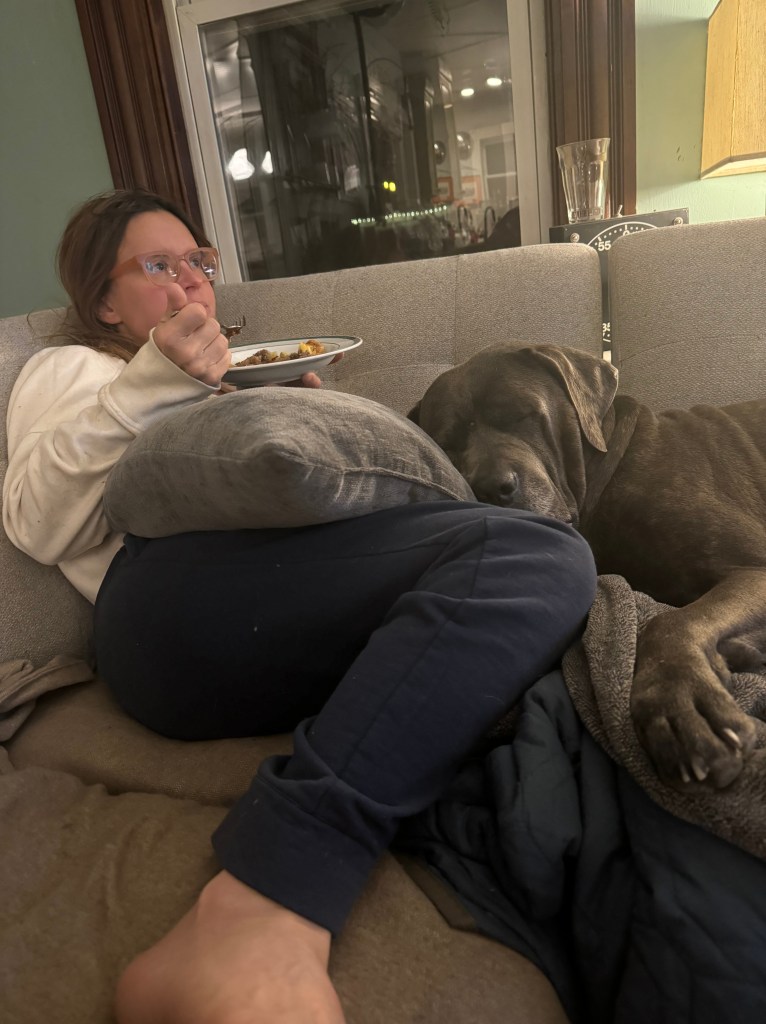
Zara is not an easy-going dog. She’s a reactive rescue with strong preferences for people and creatures. Thankfully, she adores those who primarily care for her—me, Briggs, Todd, Briggs’s dad (Ken), and my mom (Omi). She’s also wild for my neighbors Tom and Michelle, their son Gavin, and their dog, Mac.

For the past six months, a friend of Todd’s—another chef named Isaac—has been staying at his house with his yellow lab, Marco. At first, Zara wasn’t sure how she felt about either. But now, when we’re there, she does her best to nap with Marco and keep an eye on Isaac.

Still, there’s no doubting her preference for me.

Briggs can hardly walk past us without commenting: 

“Mumma, that puppy LOVES you. I mean LOVES you.”

He’s not wrong.

When she has it her way, I’m next to her—napping, writing, taking a meeting, or catching up with someone I love. She doesn’t mind the laptop on my lap, but she definitely prefers it quiet—just the sound of keys, not voices.

Lately, it’s felt harder to believe in my own value.

For most of my life, my work defined me. It gave me identity. And over the past few years, that identity has been slowly eroded—until now, I’m left trying to reshape something that feels… solid. In the past, when I felt low, I’d think of myself at 10 years old and feel proud of who I became. These days, it’s more like she’d shrug and say something clever, like, “Figures.”

Maybe it’s not a coincidence that all of this started around the time Zara came home.

My connection with neighbors. Daily walks outside. The small, unmissable proof that I still show up: keeping her safe, warm, fed, hydrated, and engaged. Staying present with Briggs as he figures out his way through adolescence.

Zara sees me. And Briggs. And somehow, Briggs and I—on our best days—see each other too. No, love isn’t enough to make it through everything. But it is something. And it’s a remarkable place to begin again.

Zara snuggling with Briggs’s favorite blanket this week, while he was at school.

Coffee & Friends

Not just for the 90s (hehe)

When a friend of mine read about the cancer journey I’m on, she texted to ask what she could do. Throughout this ordeal, I’ve tried, when people ask that question, to be as specific and practical as possible—I figure that’s best for everyone involved.

At the moment she texted me, I happened to be feeling disappointed because I was out of coffee.

When I first came home from surgery and started immunotherapy, I lost my taste for coffee, which made me sad. There’s a ritual piece to making coffee each morning that I really enjoy. But for a while, I couldn’t tolerate hot or warm beverages—I craved cold, sweet things with ample amounts of ice. I got out of the habit of picking up coffee when grocery shopping, and when I did crave it again, I’d find I often didn’t have any at home.

In a far more succinct way, I texted my friend about my coffee conundrum and asked if she wanted to help me remember to keep coffee on hand.

“I can do that,” she texted back.

And she did.

A little while later, I received an email from a coffee mail service asking for my preferences. It was nice—fun, even—to complete a survey that had nothing to do with my health or well-being. Shortly after that, coffees from around the world—roasted to my specifications—began arriving in the mail.

It’s nice, getting presents (other than bills and scary notices) in the mail. When I make coffee in the morning, I think of my friend Eva and all the incredible productions we’ve worked on together, the meals we’ve shared, and the life lessons we’ve swapped. It makes me happy, even if just for a few moments.

For me, the most challenging part about all this cancer stuff has been the abruptness with which it’s changed how I think about my time and abilities. I’ve always considered myself remarkably resilient, hard-working, and creative—someone with a tenacity to perpetually figure it out.

Lately, that’s felt less true.

Maybe that’s why my Eva coffee felt even more important this morning than usual—and why my upcoming trip to see Emily for Easter feels necessary, too.

Another lifetime when Eva and I worked on Ted Cutler’s “Outside the Box” festival in Boston.

Again with the Eyes

What it takes to see

I’m dealing with a recurrence of inflammation in my eyes from treatment — even though I haven’t had an infusion since December 26. I’m learning that stuff stays with you — and in you — much longer than I thought. Maybe that’s not just medicine, but nearly every part of life.

The solution is to return to steroid eye drops six times a day — which isn’t so bad, comparatively — but I do struggle to remember each dose (thanks, AI). The drops I take at the start and end of each day sting, though. Obviously far better than going untreated and risking devastating consequences for my vision.

Whenever my eyes are impacted, the headaches usually return. Minor, really, in the grand scheme of things — but painful and distracting nonetheless.

Since the trouble with my eyes began, I’ve been spending more time than ever taking my glasses off. For context, I’ve been wearing glasses since I was nine. If I’m leaning back in an office chair and facing a computer screen (whether my laptop or a large desktop monitor), I can’t see much unless I sit within a few inches of the screen or blow the font up into triple digits.

Sometimes, my eyes just need a break — but I’m not ready to close them.

I’ve read and heard from people who experience hearing loss that taking out their hearing devices can bring tremendous relief. There’s something remarkably peaceful about removing the thing that helps you — and, in doing so, releasing the expectations of what you “should” be able to do (not so much from others, but from yourself). At least, that’s how it feels for me.

It’s one of the most literal ways I can give myself a break. Find some relief. Let it go… until I’m ready — or at least willing — to try, to see, and to go again.

Maybe that’s why the glasses had so much power for Clark Kent and Superman. With them, Clark could see — and carry the weight of relationship, responsibility, clarity, consequence. Without them, Superman could push through with brute force and save the day — until, ultimately, he couldn’t.

In my universe, maybe putting on my glasses — having the courage to go again, to face the world with as much clarity as possible (even when it stings a little, or a lot) — gives me my own kind of superpower.

Or maybe that’s just what I need to believe.
And maybe that’s exactly what makes it real.

Me – in glasses – before the Cancer started…or before I had a clue about it…hard to say which is which. When the photo was taken, I thought I looked “thick.” All I can see now is health and beauty. Funny how that works.

Recovery Isn’t the Solve

Even when it’s the most important piece

I can’t remember exactly what it was, but years ago I read a piece by someone who had chosen to stop drinking. She wrote about how, when she first started her no-drinking journey, she expected the elimination of alcohol to solve the rest of her issues.

If she wasn’t drinking, she figured, she wouldn’t be as tired or foggy. She’d stick to a schedule, work out, eat right, make better decisions, succeed professionally, and be smarter with money.

And while some of those things did happen, they didn’t happen all at once—and certainly not in the way she had imagined would bring lasting peace.
In short: eliminating alcohol didn’t eliminate the struggle.
Even if it did make life a whole lot lovelier.

I can already feel myself getting into trouble—or causing someone else some unease—by drawing any comparison between a late-stage cancer journey and alcohol use.
That’s not my intention.
I’m not here to trigger or minimize anyone else’s experience.

I’m just here to share a few truths.
Truths from someone who has both chosen to live alcohol-free and who carries a Stage IV Melanoma diagnosis.

Alcohol left my life—or rather, I let it go—long before cancer entered the picture.
Years before.

By the time I reached my early 40s, it was clear (to me) that alcohol wasn’t doing anything positive for my life.
What started as a “dry season,” a challenge to myself, became a lifestyle.
And it turns out, I like it.

Yes, giving up alcohol eliminated hangovers and hangxiety.
But I hadn’t set out expecting it to magically fix my financial, emotional, physical, or spiritual struggles.

(Okay—maybe that’s not entirely true.
I did have this small, persistent hope that it would at least contribute something positive to my physical health.)

This is part of why, when I found myself awaiting emergency brain surgery—and a Stage IV Melanoma diagnosis that had spread to my lungs, liver, lymph nodes, and brain—after three years without alcohol and no visible signs of disease, I was furious.

The brain surgery couldn’t have gone better.
The double high-dose immunotherapy that followed was crushing on my system.
Still, after three months of treatment, my scans showed only evidence of healing in my brain and what looks like scar tissue in my lungs and liver.
No evidence of disease in my lymph nodes.

I have a thirteen-year-old son.
All of my parents are still alive.
I’m the oldest of four sisters.
I’m blessed with an ex-husband who will always be family—and a boyfriend who treats me like a unicorn (that is to say, magical and rare).I have a gaggle of colleagues, teachers, mentors, and friends—some brand new, met only because of cancer—who have become treasured family.

And when I think about all of these extraordinary people and all the remarkable experiences of knowing and loving them, it fills me with gratitude.
But it also creates a kind of longing—a feeling that can slip into sadness, confusion, and a fear that isn’t always as… inspiring as I wish it would be.

I get scared about how to spend my time.
Scared that it might still be so limited.
Scared that wrong decisions might not come with the chance to reverse or reconcile.

On those days, I do my best to focus on smaller things:
Another load of laundry.
Whether I’ve eaten anything.
Whether I’ve written a few words, walked a few steps.

I do those things with whatever peace I can muster.
And some days—especially the rainy ones, the ones that feel like it’s been raining forever—peace feels a little more elusive.

So, while I am deeply grateful not to be currently undergoing treatment, I still find it difficult, sometimes, to do much more than go through the motions.

At My Heaviest

Recovery, I’ve found, is full of strange surprises.

Yesterday, for the first time in a while, I experienced floaters—those tiny, translucent shapes breakdancing in front of my eyes for most of the day. Later, the sliced mango from Market Basket and even the dogs’ food appeared to have white stripes running through them (which I knew wasn’t the case).

This morning, the floaters and stripes are gone.

I’ll call my ophthalmologist, oncologist, and endocrinologist on Monday to leave updated messages. This is now my normal: sharing every unusual or shifting physical sensation with my medical teams and treating each as evidence of something that might be happening, returning, building, or leaving. Sometimes it’s comforting, sometimes it’s crazy-making, and often, it’s both.

These observations and feelings seem to ping-pong alongside my yo-yoing weight. I’ve fluctuated by 27 pounds in the last four months, sometimes rising or dropping as much as 10 pounds within a week. Right now, I’m up—something that doesn’t feel fantastic—but I’ve learned to pause, breathe, and see how things shift over days and weeks.

I’m also finally on the lowest dose of steroids I’ve had since October, and my body is back to craving fruits, vegetables, and lots of movement. Lately, that’s meant at-home Pilates, sessions with my trainer once a week, and long walks with Zara.

I’m still working on fully accepting and loving every iteration of my body. I look back at photos taken just before brain surgery and immunotherapy, and I’m stunned by how healthy and lovely I looked—and by how, at that moment, I also remember wishing that I looked different.

I wish cancer had evolved me past vanity, that gratitude for being alive would supersede superficial desires for a defined jawline, toned abs, or my old thigh gap…but it hasn’t.

Sadly, I’ve come to accept that I can be both grateful and shallow, all in the same breath. Perhaps recognizing this contradiction openly is its own kind of growth, a small step toward making peace with my beautifully imperfect self.

When I’m not so keen on staying positive about my body image, I do my best to focus on the good parts—like the peace of waking up at home (and not in a hospital), the love of so many good people, and the dogs, who honestly provide the most unconditional support I’ve ever known. Life is good even when I feel a bit out of my body.

Defense

Raising teens and Building Community is Not for the Weak.

According to my psychiatrist, the fact that my son, Briggs (13), still acts like a typical teenager — resisting school, avoiding chores, and showing zero interest in leaving the house unless PS5 comes along — is actually a good thing. It means that even in the chaos of a late-stage cancer diagnosis, his Dad, me, and the entire community of family, friends, and loved ones we lean on have managed to create a space where he feels safe enough to be… himself.

I’ll take the compliment — but honestly, I’d love a little less pushback whenever I suggest doing anything. Unless that “anything” is video games, it’s a full-blown negotiation. It’s typical, it’s concerning — and it drives me up a wall because I get bored easily. Also, I’m not dying, I’m living. So, we live.

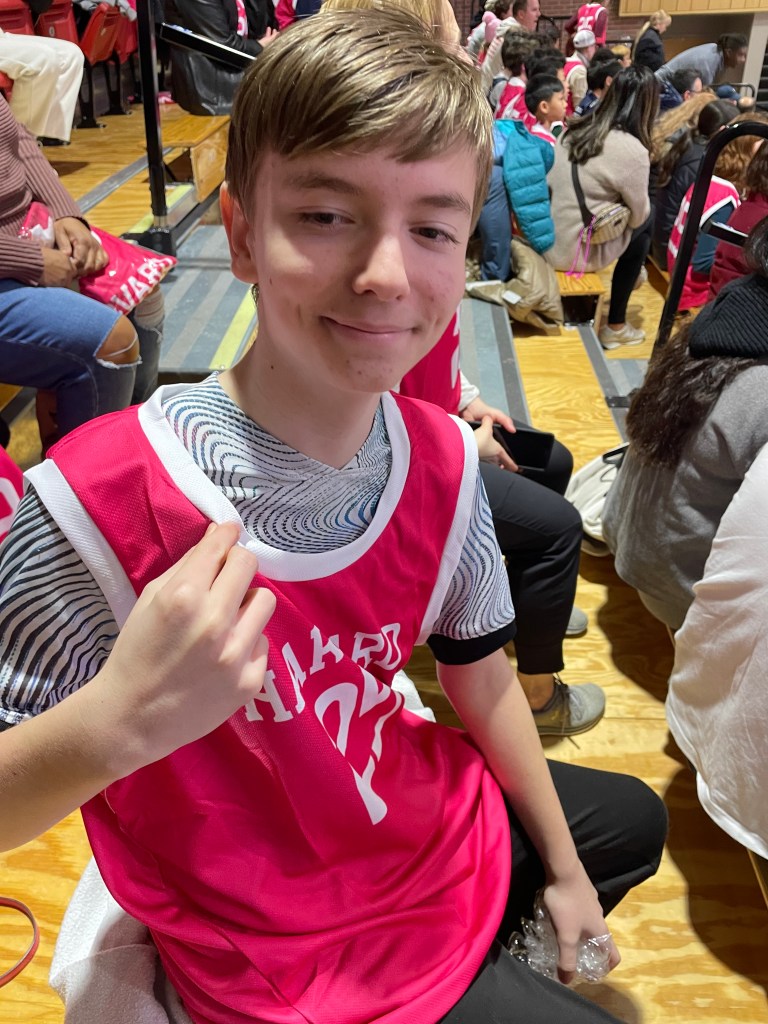
That’s why, when I caught WBZ News talking with Harvard Women’s Basketball Coach, Carrie Moore and their Cancer Awareness Night during their game against Princeton, I jumped at the chance. Friday, February 28 — I grabbed tickets for Briggs and me without a second thought.

I didn’t tell him where we were going until we were almost out the door. These days, even a trip to the grocery store is a fight, so I wasn’t expecting an easy ride into the city. Sure enough, the car ride was filled with all the reasons we should just stay home — wanting to hang with Zara (though let’s be real, he’s not the one walking her), and generally not wanting to do anything that isn’t his idea.

I let him vent. I silently judged. And I made a deal: if it was truly awful, we could leave at halftime. The only condition? Once we got there and met up with Mike — a new friend I met through our neurosurgeon, who had just wrapped up radiation treatment — Briggs had to hold it together. This night was not just about us.

The second we stepped inside, I saw it happen — the shift. The first thing that caught his eye? Free jersey giveaway. Instant win. And from the moment the game started, the Harvard women were on fire. The energy, the crowd — it was impossible not to get caught up in it.

Then came the moment that stuck with me the most. At one point, they asked everyone in the crowd to turn on their phone flashlights if they were fighting cancer. Briggs and I lit up my phone (yeah, it took both of us because typically I’m in bed by 8P), and as I looked around at the sea of lights, I could feel it — connection, community, a reminder that none of us are in this alone.

Mike joined us partway through the first quarter, and I was proud — of Briggs, of myself, of the fact that, despite his protests, we were here. Together. And not once did Briggs complain, check out, or ask to leave.

The game was electric, and halftime brought a performance from Prove Them Wrong (PTW) athletes that left the whole arena buzzing. And then, because life has a way of giving you little bonuses when you least expect it, we spotted Governor Maura Healey in the crowd. Not campaigning, not giving speeches — just there, fully present, supporting the players, the cause, and the belief that community and care matter.

The only thing that didn’t go our way? The final score. Harvard didn’t come away with the win — but this cancer-fighting Mumma sure did.

At a time when national news ties my stomach in knots, and I have to be careful how much I consume to protect my health, I’m endlessly grateful for local news, local teams, and everyone on #TeamMA who shows up—even when it’s hard—and chooses connection over isolation, truth over fear, and community over division.

No. Matter. What.

Go Team Go.

My kiddo is wicked smart.

Evidence of Disease

Finding my way as a Stage IV Cancer Patient

So, last week—after serious delays from norovirus and a respiratory infection—I finally had my follow-up brain MRI and PET scan to see what the cancer looks like now.

To level set: At this stage, doctors don’t talk in terms of remission or cure because the likelihood of cancer returning remains high. What Stage IV patients aim for is “no evidence of disease”—meaning periods of time when no visible cancer appears in the body. During these stretches, patients can step back from grueling treatments, sometimes even taking a break entirely.

The results from the brain MRI came in while I was with my neuro team, so I got to learn the same day as the scans that my brain is beautiful. The MRI continues to show only signs of healing. Even better, the damage to my pituitary gland has reversed enough that it can now be treated with oral medication. At this time, I am not a candidate for another brain surgery—a huge relief.

The PET scan results took a little longer. They were posted to my electronic medical records a few hours before Todd and I headed into Boston to meet with my oncology team. I didn’t linger on the details, but I was disappointed not to see the magic phrase, “no evidence of disease.” I prepared myself for what I was sure would be a discussion about my next round of immunotherapy.

Still, I held onto one bright spot: The word “partial” showed up a zillion times, and I knew enough to recognize that meant all instances of cancer throughout my body had been at least partially attacked and defeated. That alone was a win—far better than seeing signs of new growth.

Then, I sat down with my melanoma specialists—and it turns out, I was wrong. 🙂

When my doctor showed us my scans side by side—the one from before treatment and the one from last week—the differences were undeniable. Before treatment, my lymph nodes, liver, and lungs lit up with active cancer cells, sparking around my organs like toxic fireworks. Now? Well, there is actually no evidence of cancer in my lymph nodes. And everywhere else—there are just these still, dull dots.

My doctor explained that while it’s impossible to say for sure without surgery (and I have no interest in an investigatory operation), what they’ve learned over the years is that scans like mine—with just these dull, still dots—technically show “evidence” of something, but that evidence suggests inactive, “dead” cancer cells. Like scar tissue. Or battle wounds. (My words, not the doctor’s.)

When scans look like mine do today, there’s no data suggesting that more treatment—like immunotherapy—would prevent cancer from returning. The best course of action now? Monitoring. Brain MRIs every two months. PET scans every three months. If anything changes, I’ll restart treatment.

This is, by far, the most grateful I have ever been for a break.

Thank you to everyone who has prayed, sent well wishes, lit candles, and kept my best and highest self in your thoughts. I am deeply grateful for all of us.

I celebrated my good news at my boyfriend’s restaurant, Pastoral, on Valentine’s Day, with my son, Briggs (left) and nephew Nico (right).

Seeing it Another Way

Everyone I know who wears glasses or corrective lenses has their version of the “seeing the leaves through the trees” moment.

When you don’t realize your vision is compromised, you assume that everyone sees leaves as blurry blobs and dots. Then, you get your glasses or lenses, walk outside, and suddenly—individual leaves come into focus. The world shifts. And with that shift comes the inevitable question: What else haven’t I been seeing?

I’ve never spent much time thinking about how personal sight really is. I’ve known, in a general sense, that we each hear, feel, and taste things differently. But when it comes to seeing, it’s easier to assume that while we might notice different details, we still see the same tree.

Then cancer gave me an eye disease. And that eye disease came with vision loss, pain, inflammation, oral steroids, topical steroids—and, on Tuesday, a follow-up ophthalmology appointment that turned into unscheduled laser surgery to prevent my retina from detaching.

The surgery wasn’t exactly painful, but it was wildly uncomfortable. I struggled to get through it. What I decided to play on loop in my mind was: I’m living in the future. Because it’s the truth. Here I am, just months after a late-stage cancer diagnosis and emergency brain surgery, still in my world—getting my eye fixed by a laser. And after all that, I’d even get to go home and sleep in my own bed.

(Even if I didn’t know, that norovirus would hit me later that night, leaving me to spend the next 18 hours making the slow, messy commute between the bed and the bathroom.)

The norovirus made it impossible for me to keep my PET scan appointment yesterday—a scan I’d been counting on to see how well the treatments were attacking the cancer in my lungs, liver, and lymph nodes. Missing that scan was disappointing. I thought yesterday would be a day of answers. Instead, it was another day of waiting.

But by this afternoon, when solid food and electrolytes stayed down, I realized I could see it differently:

Maybe my body just needed more time to clear out the junk before giving me a good, clean look at everything. And that’s what will happen on February 10.


This lovey girl – Zara Dew didn’t leave my side through the whole ordeal. I love her so much.

Bucket Lists & Pie Dreams

Bucket lists usually feature big-ticket items—those grand, expensive, or once-in-a-lifetime dreams you can’t wait to experience. But what about the smaller, simpler wishes? The ones that quietly live in your mind, always seeming just out of reach for no good reason?

Here’s a slice of life example:

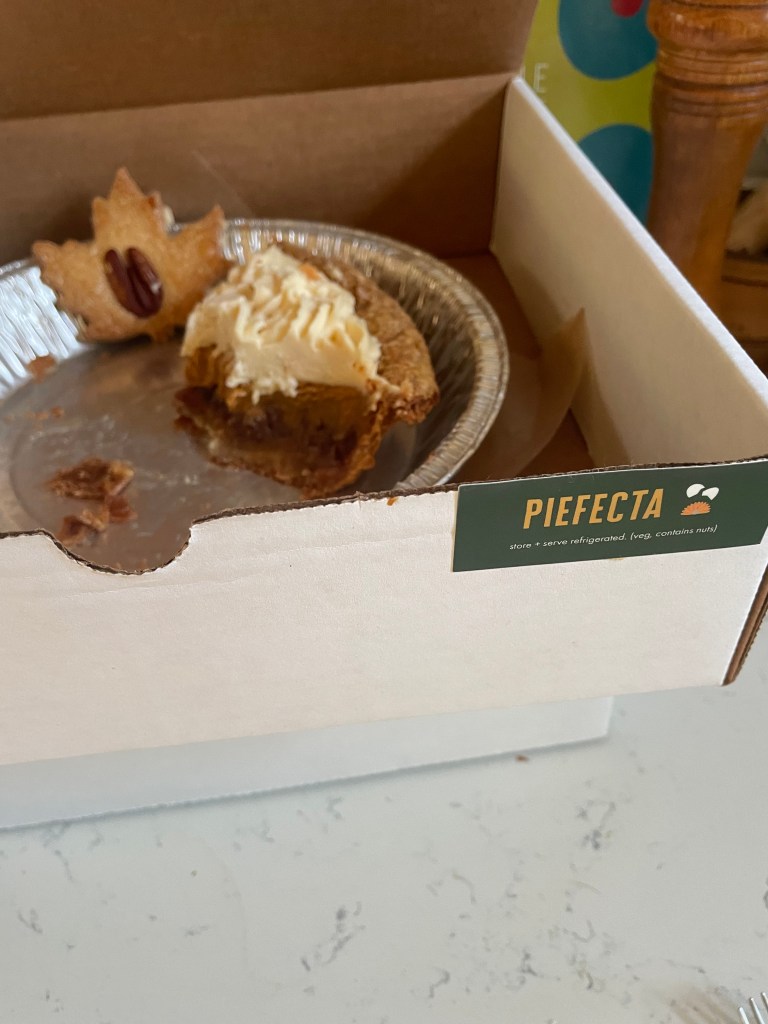
For about five years, I’ve talked about ordering the Pifecta Pie from Flour Bakery for Thanksgiving. Every year, it’s been on my radar. Every year, I’ve meant to make it happen. And every year, I didn’t.

It’s not like it was difficult. Flour makes the process ridiculously simple—you can order online, call ahead, or just walk into one of their Massachusetts locations (several of which I pass by when I’m in Boston). But life got busy, and deadlines were missed. And the pie? It eluded me.

Until this year.

These days, I’ve been in Boston more often for infusions and medical appointments. On an early November trip, I decided to stop into Flour and place my order. And just like that, the pie was mine—picked up the Tuesday before Thanksgiving, ready to grace our table.

Finally, my long-awaited pie dreams came true.

The Pifecta Pie? Pure genius. It’s brilliantly layered with just the right balance of three classic flavors. But for me, it wasn’t just about the taste. There was an added sweetness in finally following through on something I’d wanted for so long. That flavor—the satisfaction of getting what you really want—might just be the best layer of all.

Knowing What You Want

I often still wrestle with knowing exactly what I want. And that hesitation—feeling unsure—is frustrating. It’s hard to move forward when you don’t have a clear direction. But here’s the thing: waiting for clarity, as uncomfortable as it might be, is worth it.

When I give myself the space to figure out what I really want, the result is always richer. It’s like that pie—layered, thoughtful, and deeply satisfying.

So, when I find myself stuck in indecision, I intentionally take a step back—even stop—and ease into the trust that knowing what I want will come. And when it does, it’s worth savoring.

Life is Sleep & Life is Good

For the better part of seven years, I’ve been fiercely committed to prioritizing sleep. I’m sure I’ve written about it before—probably more than once. But since my cancer diagnosis, emergency brain surgery, and ongoing treatment, this commitment has only grown stronger.

Maybe that’s why, just a few weeks after surgery, I completely lost my taste for coffee and caffeine. It’s strange, but it feels right.

These days, my routine is simple and steady: I’m in bed by 7 or 7:30 p.m., and I stay there until Zara nudges me awake somewhere between 5 and 6:30 a.m. for our morning walk.

We head out for a brisk mile or two through the neighborhood. Then it’s back home to get Briggs up and ready for school. Breakfast is usually egg sandwiches and hashbrowns (always with plenty of orange juice), followed by settling into the day’s work.

I’ll admit, I can’t recall going to bed this early since I was a kid. But I’m not mad about it. The deep sleep has been restorative in ways I didn’t expect. It leaves me feeling ready for the morning walks, for the day ahead, for the life I’m building now..

It feels natural to let my head hit the pillow when the moon is up and the world is dark.

Don’t get me wrong—I don’t love every piece of this now normal. There’s plenty I’d trade. But this part—this deep, healing sleep—is part of the good stuff. I’ll gladly take it…I’m grateful for it.

Sleep tight.

That’s me and Q (one of three on my canine nurse team) – he’s a top snuggler.