Again with the Eyes

What it takes to see

I’m dealing with a recurrence of inflammation in my eyes from treatment — even though I haven’t had an infusion since December 26. I’m learning that stuff stays with you — and in you — much longer than I thought. Maybe that’s not just medicine, but nearly every part of life.

The solution is to return to steroid eye drops six times a day — which isn’t so bad, comparatively — but I do struggle to remember each dose (thanks, AI). The drops I take at the start and end of each day sting, though. Obviously far better than going untreated and risking devastating consequences for my vision.

Whenever my eyes are impacted, the headaches usually return. Minor, really, in the grand scheme of things — but painful and distracting nonetheless.

Since the trouble with my eyes began, I’ve been spending more time than ever taking my glasses off. For context, I’ve been wearing glasses since I was nine. If I’m leaning back in an office chair and facing a computer screen (whether my laptop or a large desktop monitor), I can’t see much unless I sit within a few inches of the screen or blow the font up into triple digits.

Sometimes, my eyes just need a break — but I’m not ready to close them.

I’ve read and heard from people who experience hearing loss that taking out their hearing devices can bring tremendous relief. There’s something remarkably peaceful about removing the thing that helps you — and, in doing so, releasing the expectations of what you “should” be able to do (not so much from others, but from yourself). At least, that’s how it feels for me.

It’s one of the most literal ways I can give myself a break. Find some relief. Let it go… until I’m ready — or at least willing — to try, to see, and to go again.

Maybe that’s why the glasses had so much power for Clark Kent and Superman. With them, Clark could see — and carry the weight of relationship, responsibility, clarity, consequence. Without them, Superman could push through with brute force and save the day — until, ultimately, he couldn’t.

In my universe, maybe putting on my glasses — having the courage to go again, to face the world with as much clarity as possible (even when it stings a little, or a lot) — gives me my own kind of superpower.

Or maybe that’s just what I need to believe.
And maybe that’s exactly what makes it real.

Me – in glasses – before the Cancer started…or before I had a clue about it…hard to say which is which. When the photo was taken, I thought I looked “thick.” All I can see now is health and beauty. Funny how that works.
Recovery Isn’t the Solve

Even when it’s the most important piece

I can’t remember exactly what it was, but years ago I read a piece by someone who had chosen to stop drinking. She wrote about how, when she first started her no-drinking journey, she expected the elimination of alcohol to solve the rest of her issues.

If she wasn’t drinking, she figured, she wouldn’t be as tired or foggy. She’d stick to a schedule, work out, eat right, make better decisions, succeed professionally, and be smarter with money.

And while some of those things did happen, they didn’t happen all at once—and certainly not in the way she had imagined would bring lasting peace.
In short: eliminating alcohol didn’t eliminate the struggle.
Even if it did make life a whole lot lovelier.

I can already feel myself getting into trouble—or causing someone else some unease—by drawing any comparison between a late-stage cancer journey and alcohol use.
That’s not my intention.
I’m not here to trigger or minimize anyone else’s experience.

I’m just here to share a few truths.
Truths from someone who has both chosen to live alcohol-free and who carries a Stage IV Melanoma diagnosis.

Alcohol left my life—or rather, I let it go—long before cancer entered the picture.
Years before.

By the time I reached my early 40s, it was clear (to me) that alcohol wasn’t doing anything positive for my life.
What started as a “dry season,” a challenge to myself, became a lifestyle.
And it turns out, I like it.

Yes, giving up alcohol eliminated hangovers and hangxiety.
But I hadn’t set out expecting it to magically fix my financial, emotional, physical, or spiritual struggles.

(Okay—maybe that’s not entirely true.
I did have this small, persistent hope that it would at least contribute something positive to my physical health.)

This is part of why, when I found myself awaiting emergency brain surgery—and a Stage IV Melanoma diagnosis that had spread to my lungs, liver, lymph nodes, and brain—after three years without alcohol and no visible signs of disease, I was furious.

The brain surgery couldn’t have gone better.
The double high-dose immunotherapy that followed was crushing on my system.
Still, after three months of treatment, my scans showed only evidence of healing in my brain and what looks like scar tissue in my lungs and liver.
No evidence of disease in my lymph nodes.

I have a thirteen-year-old son.
All of my parents are still alive.
I’m the oldest of four sisters.
I’m blessed with an ex-husband who will always be family—and a boyfriend who treats me like a unicorn (that is to say, magical and rare).I have a gaggle of colleagues, teachers, mentors, and friends—some brand new, met only because of cancer—who have become treasured family.

And when I think about all of these extraordinary people and all the remarkable experiences of knowing and loving them, it fills me with gratitude.
But it also creates a kind of longing—a feeling that can slip into sadness, confusion, and a fear that isn’t always as… inspiring as I wish it would be.

I get scared about how to spend my time.
Scared that it might still be so limited.
Scared that wrong decisions might not come with the chance to reverse or reconcile.

On those days, I do my best to focus on smaller things:
Another load of laundry.
Whether I’ve eaten anything.
Whether I’ve written a few words, walked a few steps.

I do those things with whatever peace I can muster.
And some days—especially the rainy ones, the ones that feel like it’s been raining forever—peace feels a little more elusive.

So, while I am deeply grateful not to be currently undergoing treatment, I still find it difficult, sometimes, to do much more than go through the motions.

At My Heaviest

Recovery, I’ve found, is full of strange surprises.

Yesterday, for the first time in a while, I experienced floaters—those tiny, translucent shapes breakdancing in front of my eyes for most of the day. Later, the sliced mango from Market Basket and even the dogs’ food appeared to have white stripes running through them (which I knew wasn’t the case).

This morning, the floaters and stripes are gone.

I’ll call my ophthalmologist, oncologist, and endocrinologist on Monday to leave updated messages. This is now my normal: sharing every unusual or shifting physical sensation with my medical teams and treating each as evidence of something that might be happening, returning, building, or leaving. Sometimes it’s comforting, sometimes it’s crazy-making, and often, it’s both.

These observations and feelings seem to ping-pong alongside my yo-yoing weight. I’ve fluctuated by 27 pounds in the last four months, sometimes rising or dropping as much as 10 pounds within a week. Right now, I’m up—something that doesn’t feel fantastic—but I’ve learned to pause, breathe, and see how things shift over days and weeks.

I’m also finally on the lowest dose of steroids I’ve had since October, and my body is back to craving fruits, vegetables, and lots of movement. Lately, that’s meant at-home Pilates, sessions with my trainer once a week, and long walks with Zara.

I’m still working on fully accepting and loving every iteration of my body. I look back at photos taken just before brain surgery and immunotherapy, and I’m stunned by how healthy and lovely I looked—and by how, at that moment, I also remember wishing that I looked different.

I wish cancer had evolved me past vanity, that gratitude for being alive would supersede superficial desires for a defined jawline, toned abs, or my old thigh gap…but it hasn’t.

Sadly, I’ve come to accept that I can be both grateful and shallow, all in the same breath. Perhaps recognizing this contradiction openly is its own kind of growth, a small step toward making peace with my beautifully imperfect self.

When I’m not so keen on staying positive about my body image, I do my best to focus on the good parts—like the peace of waking up at home (and not in a hospital), the love of so many good people, and the dogs, who honestly provide the most unconditional support I’ve ever known. Life is good even when I feel a bit out of my body.

Evidence of Disease

Finding my way as a Stage IV Cancer Patient

So, last week—after serious delays from norovirus and a respiratory infection—I finally had my follow-up brain MRI and PET scan to see what the cancer looks like now.

To level set: At this stage, doctors don’t talk in terms of remission or cure because the likelihood of cancer returning remains high. What Stage IV patients aim for is “no evidence of disease”—meaning periods of time when no visible cancer appears in the body. During these stretches, patients can step back from grueling treatments, sometimes even taking a break entirely.

The results from the brain MRI came in while I was with my neuro team, so I got to learn the same day as the scans that my brain is beautiful. The MRI continues to show only signs of healing. Even better, the damage to my pituitary gland has reversed enough that it can now be treated with oral medication. At this time, I am not a candidate for another brain surgery—a huge relief.

The PET scan results took a little longer. They were posted to my electronic medical records a few hours before Todd and I headed into Boston to meet with my oncology team. I didn’t linger on the details, but I was disappointed not to see the magic phrase, “no evidence of disease.” I prepared myself for what I was sure would be a discussion about my next round of immunotherapy.

Still, I held onto one bright spot: The word “partial” showed up a zillion times, and I knew enough to recognize that meant all instances of cancer throughout my body had been at least partially attacked and defeated. That alone was a win—far better than seeing signs of new growth.

Then, I sat down with my melanoma specialists—and it turns out, I was wrong. 🙂

When my doctor showed us my scans side by side—the one from before treatment and the one from last week—the differences were undeniable. Before treatment, my lymph nodes, liver, and lungs lit up with active cancer cells, sparking around my organs like toxic fireworks. Now? Well, there is actually no evidence of cancer in my lymph nodes. And everywhere else—there are just these still, dull dots.

My doctor explained that while it’s impossible to say for sure without surgery (and I have no interest in an investigatory operation), what they’ve learned over the years is that scans like mine—with just these dull, still dots—technically show “evidence” of something, but that evidence suggests inactive, “dead” cancer cells. Like scar tissue. Or battle wounds. (My words, not the doctor’s.)

When scans look like mine do today, there’s no data suggesting that more treatment—like immunotherapy—would prevent cancer from returning. The best course of action now? Monitoring. Brain MRIs every two months. PET scans every three months. If anything changes, I’ll restart treatment.

This is, by far, the most grateful I have ever been for a break.

Thank you to everyone who has prayed, sent well wishes, lit candles, and kept my best and highest self in your thoughts. I am deeply grateful for all of us.

I celebrated my good news at my boyfriend’s restaurant, Pastoral, on Valentine’s Day, with my son, Briggs (left) and nephew Nico (right).

Life is Sleep & Life is Good

For the better part of seven years, I’ve been fiercely committed to prioritizing sleep. I’m sure I’ve written about it before—probably more than once. But since my cancer diagnosis, emergency brain surgery, and ongoing treatment, this commitment has only grown stronger.

Maybe that’s why, just a few weeks after surgery, I completely lost my taste for coffee and caffeine. It’s strange, but it feels right.

These days, my routine is simple and steady: I’m in bed by 7 or 7:30 p.m., and I stay there until Zara nudges me awake somewhere between 5 and 6:30 a.m. for our morning walk.

We head out for a brisk mile or two through the neighborhood. Then it’s back home to get Briggs up and ready for school. Breakfast is usually egg sandwiches and hashbrowns (always with plenty of orange juice), followed by settling into the day’s work.

I’ll admit, I can’t recall going to bed this early since I was a kid. But I’m not mad about it. The deep sleep has been restorative in ways I didn’t expect. It leaves me feeling ready for the morning walks, for the day ahead, for the life I’m building now..

It feels natural to let my head hit the pillow when the moon is up and the world is dark.

Don’t get me wrong—I don’t love every piece of this now normal. There’s plenty I’d trade. But this part—this deep, healing sleep—is part of the good stuff. I’ll gladly take it…I’m grateful for it.

Sleep tight.

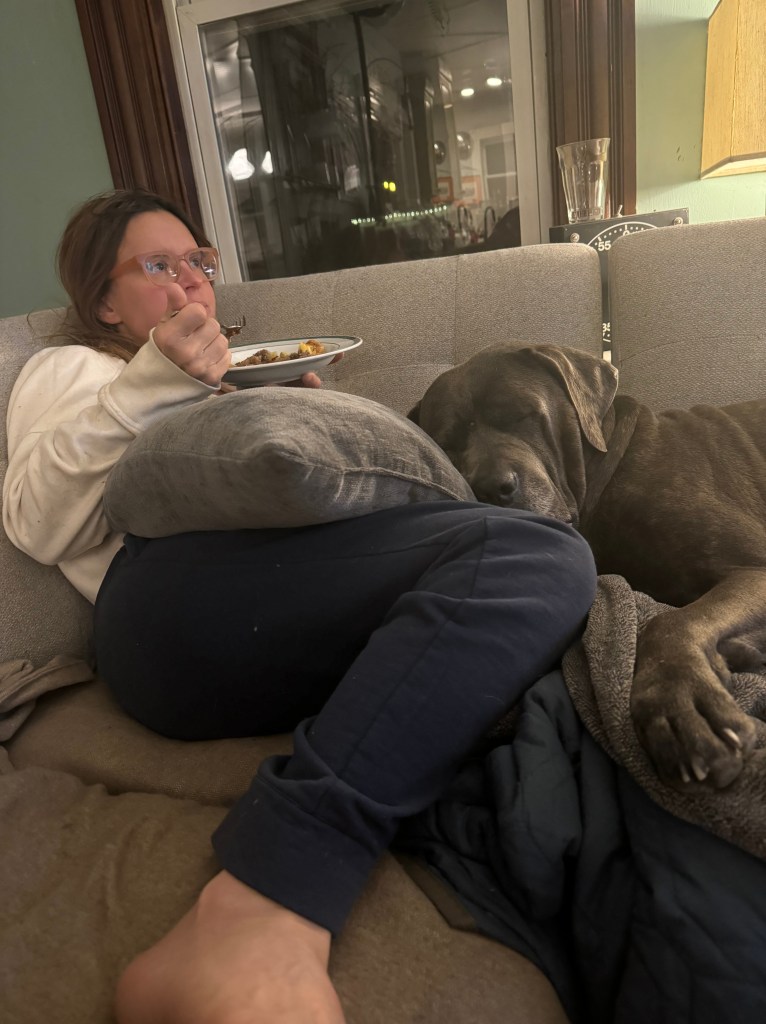
That’s me and Q (one of three on my canine nurse team) – he’s a top snuggler.

Wordle

Most days, I play Wordle from the NY Times.

On the days when my son Briggs is with me, we do it together. On days like today, when he’s with his dad, I typically text them how many tries it took me to solve it, and then they tell me the same.

His dad and I are divorced, but the three of us are still (and always) a family.

The Wordle play is both connective and playfully competitive.

Truth: Briggs and his dad typically solve Wordle in fewer tries than I do. I usually credit them with being better at puzzles. It’s 100% all in fun, and none of us are engaged in any kind of “who’s smarter than who” competition… though our son is a teenager, so by default, he knows everything. 😉

I had a bit of a revelation during my solo Wordle match yesterday.

I was approaching my third guess. I already knew four of the five letters: I, E, L, and T, and I knew that the T was at the end. Even though I had all this information, my brain couldn’t unsee the word “FIELD”—even though I knew that couldn’t be right.

After getting stuck on “FIELD” for what felt far too long, all I could hear were words that rhymed with “FIELD”—none of which could be the solution.

I was in a loop…until…I allowed myself to play with an answer I knew wasn’t “it.”

I submitted F-I-E-L-D and saw all the letters, except for the D, signal that I was getting closer.

Suddenly, “FILET” became visible, and I solved it in four.

It feels almost silly, but up until yesterday, I was approaching the game as a race to win with the fewest guesses. Now, I don’t think that’s the point whatsoever.

I think the object of the game is to show me how to shift my thinking, recognize when loops are hurting or not helping, and remember that not every attempt is about getting it right but rather about getting new information.

It’s a mindset I’ll carry into tomorrow’s biopsy.

Rage to Rush

When I was 20, I went to Luxembourg through my college’s study abroad program. While there, a friend from school and I decided to spend spring break in Barcelona. On that trip, I got mugged and then pick-pocketed on the train ride home.

When I called my mom from the French railways—through the US Embassy—for the second time in less than twenty-four hours because I’d been robbed—her first question was: “Did you really get pickpocketed, or are you just too embarrassed that you lost your wallet again?”

Not a great moment for either of us.

Twenty-three years later, I understand my mom’s reaction a bit better.

The only thing worse than having ADHD is living with someone who has ADHD. I kid, though, it’s funny because it’s true.

Neither my mom nor I knew I had ADHD growing up, and I only have a diagnosis now because I advocated for my kiddo to be evaluated at a young age. Turns out he got it from his momma.

I grew up losing everything: backpacks, sweatshirts, shoes, and expensive sporting equipment. Once (this demonstrates how small a town I grew up in), my mom gave me a signed blank check to bring to school so I could put down a deposit on my high school class ring. I took the check off the kitchen table and went to school. That night, the phone rang. My mom answered and thanked the person on the other end over and over.

“Amanda?!?!”

“Yeah?”

“Did you put the deposit down on your ring today?”

“Oh shoot, I forgot – but I took the check. They’ll be there tomorrow.”

“Where’s the check?”

“I don’t know, probably in my car.”

“Actually, it’s not because someone from the church recognized my name and just called. When she went to pick up her kid, she found the check lying in the school’s parking lot.”

“Wow, super lucky she didn’t use it.”

“AMANDA!”

Charming and sickening versions of this story exist for every stage of my life.

I mean, case and point, I can recall these exact conversations more than 20 years later, but just this morning, I lost my phone because I made my bed.

Not that anyone saw, but I’m assuming the visual of me barking at Alexa to keep calling my phone and my twelve-year-old using his good ears to find the buzz was the stuff of bad sitcoms.

After successfully uncovering the phone from under a comforter and quilt, Briggs said, “Am I good or what?”

I told him he was the best, and I meant it.

My ADHD rage quickly morphed into a rush of dopamine. And it felt very real to me that even though some things don’t change, they do.

As soon as I wrote that second to last sentence, Tom Sawyer started playing in my head.