What did we do before Zara?

The impossibility of shared unconditional love

Because I was older—10 and then 14—when my last two sisters, Maria and Teresa, were born, I have very clear memories of cooing over them with my mom. We’d marvel at their tiny-ness and say things like:

“Can you even believe she used to not be here?”

We’d share in our version of loving nos.

As an only child, Briggs didn’t have any of that. Or hadn’t, until we brought Zara into our family three years ago this December.

Just this morning, his stomach hurting, none of us too quick to get out of bed and into the unseasonably wintery spring, he said: 

“Can you believe there was a time before Zara Dew? What did we even do without her?”

Then we both melted into full weekend puppy cuddles.

Zara is not an easy-going dog. She’s a reactive rescue with strong preferences for people and creatures. Thankfully, she adores those who primarily care for her—me, Briggs, Todd, Briggs’s dad (Ken), and my mom (Omi). She’s also wild for my neighbors Tom and Michelle, their son Gavin, and their dog, Mac.

For the past six months, a friend of Todd’s—another chef named Isaac—has been staying at his house with his yellow lab, Marco. At first, Zara wasn’t sure how she felt about either. But now, when we’re there, she does her best to nap with Marco and keep an eye on Isaac.

Still, there’s no doubting her preference for me.

Briggs can hardly walk past us without commenting: 

“Mumma, that puppy LOVES you. I mean LOVES you.”

He’s not wrong.

When she has it her way, I’m next to her—napping, writing, taking a meeting, or catching up with someone I love. She doesn’t mind the laptop on my lap, but she definitely prefers it quiet—just the sound of keys, not voices.

Lately, it’s felt harder to believe in my own value.

For most of my life, my work defined me. It gave me identity. And over the past few years, that identity has been slowly eroded—until now, I’m left trying to reshape something that feels… solid. In the past, when I felt low, I’d think of myself at 10 years old and feel proud of who I became. These days, it’s more like she’d shrug and say something clever, like, “Figures.”

Maybe it’s not a coincidence that all of this started around the time Zara came home.

My connection with neighbors. Daily walks outside. The small, unmissable proof that I still show up: keeping her safe, warm, fed, hydrated, and engaged. Staying present with Briggs as he figures out his way through adolescence.

Zara sees me. And Briggs. And somehow, Briggs and I—on our best days—see each other too. No, love isn’t enough to make it through everything. But it is something. And it’s a remarkable place to begin again.

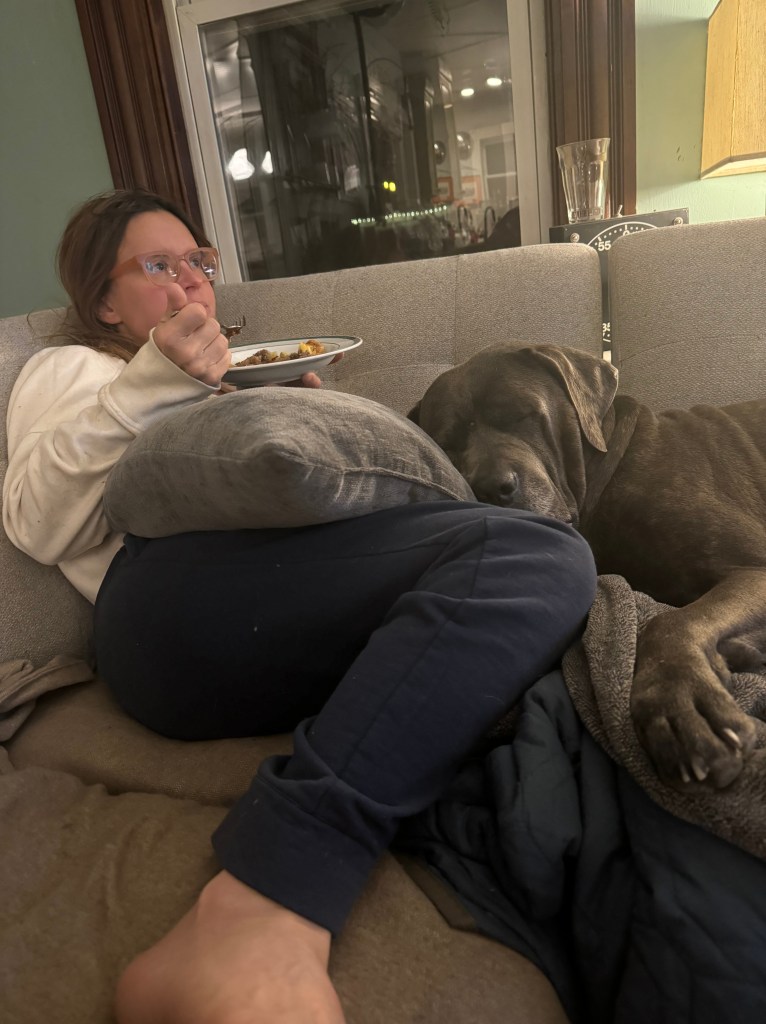
Zara snuggling with Briggs’s favorite blanket this week, while he was at school.

At My Heaviest

Recovery, I’ve found, is full of strange surprises.

Yesterday, for the first time in a while, I experienced floaters—those tiny, translucent shapes breakdancing in front of my eyes for most of the day. Later, the sliced mango from Market Basket and even the dogs’ food appeared to have white stripes running through them (which I knew wasn’t the case).

This morning, the floaters and stripes are gone.

I’ll call my ophthalmologist, oncologist, and endocrinologist on Monday to leave updated messages. This is now my normal: sharing every unusual or shifting physical sensation with my medical teams and treating each as evidence of something that might be happening, returning, building, or leaving. Sometimes it’s comforting, sometimes it’s crazy-making, and often, it’s both.

These observations and feelings seem to ping-pong alongside my yo-yoing weight. I’ve fluctuated by 27 pounds in the last four months, sometimes rising or dropping as much as 10 pounds within a week. Right now, I’m up—something that doesn’t feel fantastic—but I’ve learned to pause, breathe, and see how things shift over days and weeks.

I’m also finally on the lowest dose of steroids I’ve had since October, and my body is back to craving fruits, vegetables, and lots of movement. Lately, that’s meant at-home Pilates, sessions with my trainer once a week, and long walks with Zara.

I’m still working on fully accepting and loving every iteration of my body. I look back at photos taken just before brain surgery and immunotherapy, and I’m stunned by how healthy and lovely I looked—and by how, at that moment, I also remember wishing that I looked different.

I wish cancer had evolved me past vanity, that gratitude for being alive would supersede superficial desires for a defined jawline, toned abs, or my old thigh gap…but it hasn’t.

Sadly, I’ve come to accept that I can be both grateful and shallow, all in the same breath. Perhaps recognizing this contradiction openly is its own kind of growth, a small step toward making peace with my beautifully imperfect self.

When I’m not so keen on staying positive about my body image, I do my best to focus on the good parts—like the peace of waking up at home (and not in a hospital), the love of so many good people, and the dogs, who honestly provide the most unconditional support I’ve ever known. Life is good even when I feel a bit out of my body.

Life is Sleep & Life is Good

For the better part of seven years, I’ve been fiercely committed to prioritizing sleep. I’m sure I’ve written about it before—probably more than once. But since my cancer diagnosis, emergency brain surgery, and ongoing treatment, this commitment has only grown stronger.

Maybe that’s why, just a few weeks after surgery, I completely lost my taste for coffee and caffeine. It’s strange, but it feels right.

These days, my routine is simple and steady: I’m in bed by 7 or 7:30 p.m., and I stay there until Zara nudges me awake somewhere between 5 and 6:30 a.m. for our morning walk.

We head out for a brisk mile or two through the neighborhood. Then it’s back home to get Briggs up and ready for school. Breakfast is usually egg sandwiches and hashbrowns (always with plenty of orange juice), followed by settling into the day’s work.

I’ll admit, I can’t recall going to bed this early since I was a kid. But I’m not mad about it. The deep sleep has been restorative in ways I didn’t expect. It leaves me feeling ready for the morning walks, for the day ahead, for the life I’m building now..

It feels natural to let my head hit the pillow when the moon is up and the world is dark.

Don’t get me wrong—I don’t love every piece of this now normal. There’s plenty I’d trade. But this part—this deep, healing sleep—is part of the good stuff. I’ll gladly take it…I’m grateful for it.

Sleep tight.

That’s me and Q (one of three on my canine nurse team) – he’s a top snuggler.

Rage to Rush

When I was 20, I went to Luxembourg through my college’s study abroad program. While there, a friend from school and I decided to spend spring break in Barcelona. On that trip, I got mugged and then pick-pocketed on the train ride home.

When I called my mom from the French railways—through the US Embassy—for the second time in less than twenty-four hours because I’d been robbed—her first question was: “Did you really get pickpocketed, or are you just too embarrassed that you lost your wallet again?”

Not a great moment for either of us.

Twenty-three years later, I understand my mom’s reaction a bit better.

The only thing worse than having ADHD is living with someone who has ADHD. I kid, though, it’s funny because it’s true.

Neither my mom nor I knew I had ADHD growing up, and I only have a diagnosis now because I advocated for my kiddo to be evaluated at a young age. Turns out he got it from his momma.

I grew up losing everything: backpacks, sweatshirts, shoes, and expensive sporting equipment. Once (this demonstrates how small a town I grew up in), my mom gave me a signed blank check to bring to school so I could put down a deposit on my high school class ring. I took the check off the kitchen table and went to school. That night, the phone rang. My mom answered and thanked the person on the other end over and over.

“Amanda?!?!”

“Yeah?”

“Did you put the deposit down on your ring today?”

“Oh shoot, I forgot – but I took the check. They’ll be there tomorrow.”

“Where’s the check?”

“I don’t know, probably in my car.”

“Actually, it’s not because someone from the church recognized my name and just called. When she went to pick up her kid, she found the check lying in the school’s parking lot.”

“Wow, super lucky she didn’t use it.”

“AMANDA!”

Charming and sickening versions of this story exist for every stage of my life.

I mean, case and point, I can recall these exact conversations more than 20 years later, but just this morning, I lost my phone because I made my bed.

Not that anyone saw, but I’m assuming the visual of me barking at Alexa to keep calling my phone and my twelve-year-old using his good ears to find the buzz was the stuff of bad sitcoms.

After successfully uncovering the phone from under a comforter and quilt, Briggs said, “Am I good or what?”

I told him he was the best, and I meant it.

My ADHD rage quickly morphed into a rush of dopamine. And it felt very real to me that even though some things don’t change, they do.

As soon as I wrote that second to last sentence, Tom Sawyer started playing in my head.