For the better part of seven years, I’ve been fiercely committed to prioritizing sleep. I’m sure I’ve written about it before—probably more than once. But since my cancer diagnosis, emergency brain surgery, and ongoing treatment, this commitment has only grown stronger.
Maybe that’s why, just a few weeks after surgery, I completely lost my taste for coffee and caffeine. It’s strange, but it feels right.
These days, my routine is simple and steady: I’m in bed by 7 or 7:30 p.m., and I stay there until Zara nudges me awake somewhere between 5 and 6:30 a.m. for our morning walk.
We head out for a brisk mile or two through the neighborhood. Then it’s back home to get Briggs up and ready for school. Breakfast is usually egg sandwiches and hashbrowns (always with plenty of orange juice), followed by settling into the day’s work.
I’ll admit, I can’t recall going to bed this early since I was a kid. But I’m not mad about it. The deep sleep has been restorative in ways I didn’t expect. It leaves me feeling ready for the morning walks, for the day ahead, for the life I’m building now..
It feels natural to let my head hit the pillow when the moon is up and the world is dark.
Don’t get me wrong—I don’t love every piece of this now normal. There’s plenty I’d trade. But this part—this deep, healing sleep—is part of the good stuff. I’ll gladly take it…I’m grateful for it.
Sleep tight.
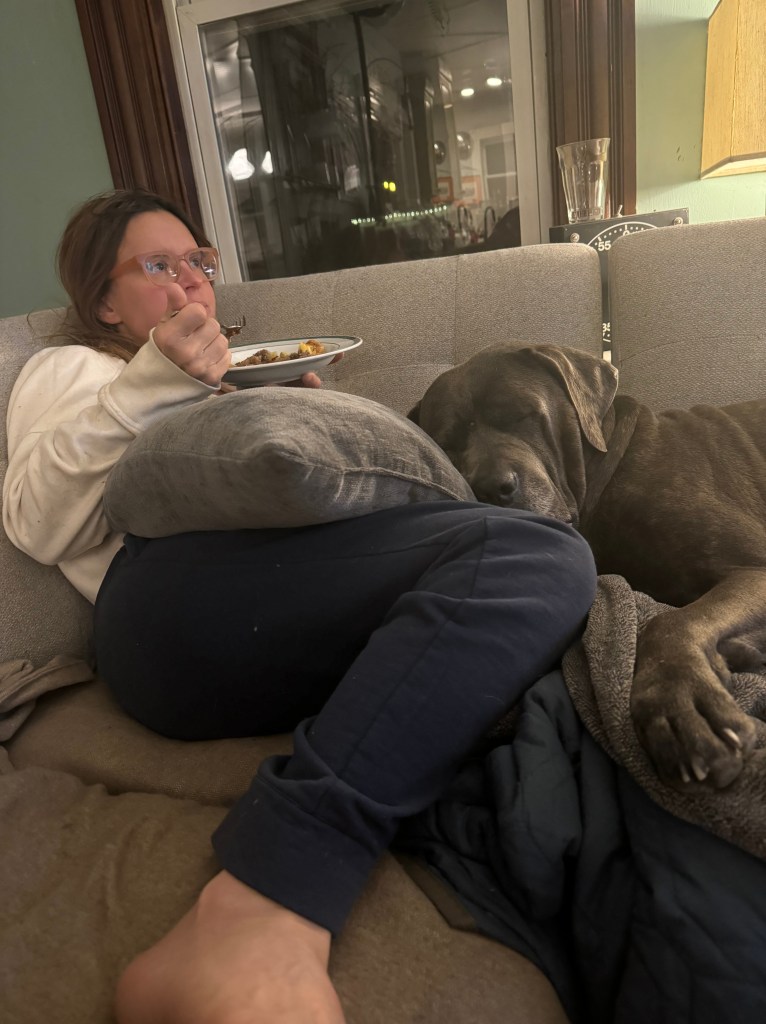
That’s me and Q (one of three on my canine nurse team) – he’s a top snuggler.
I have this memory–either from grade school or grad school (honestly, I can’t remember) of a teacher/professor/instructor telling me that most writers avoid second-person narration.
First-person = I
Second-person = you
Third-person = omniscient/all-knowing/god
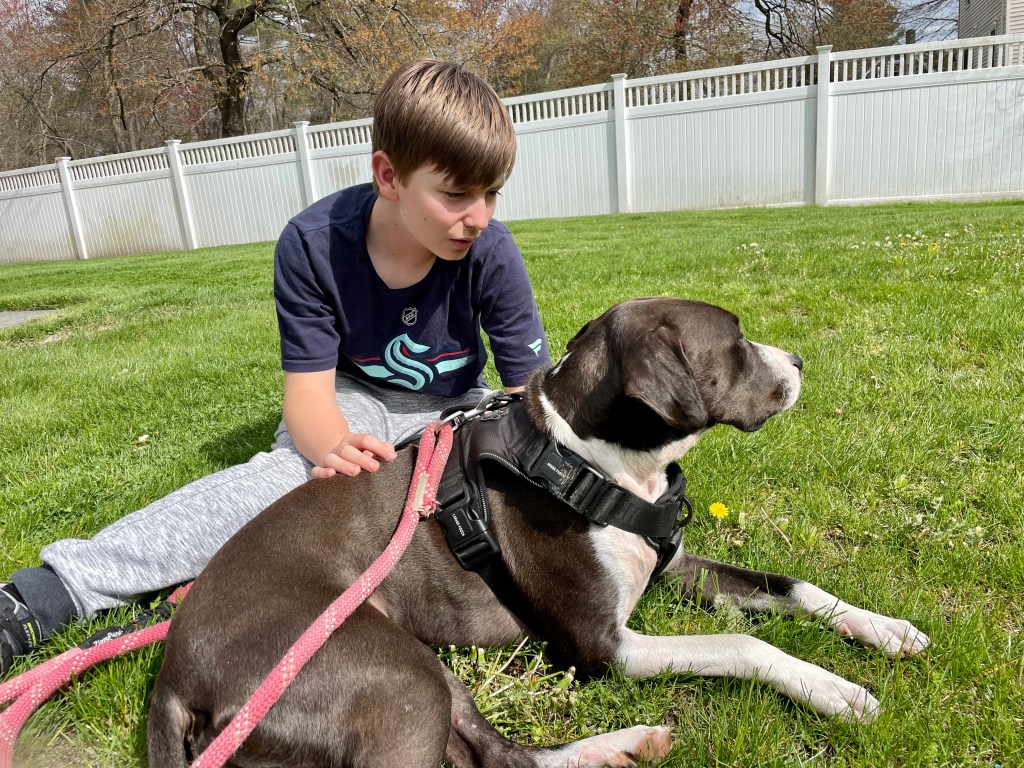
Now, the other day, on a walk with my rescue pit, Zara, at 5:30 in the morning, before coffee, but after brushing my teeth, remembering poop bags, lacing up my sneakers, and starting the coffee maker so that the water dressed in brown would be ready for me upon our return–I remembered that I did not make my bed.
And then I remembered that book, or graduation speech, or graduation speech turned book, by a retired armed serviceman (I think Naval officer, but I’m doing my best to write this without doing so much research) about the importance of making your bed—starting your day with an accomplishment. The tactical and practical approach stuck with me.
Some posts about my checkered relationship with bedmaking are buried in this blog. I resisted it for most of my childhood and early adult years–then became an evangelist for it for the better part of my thirties and early forties (much thanks to that speech/book and its reinforcement in a podcast called Last 8% Morning that I also followed religiously during the height of the COVID pandemic).
On this particular walk, my neurodivergent brain leaped from the lecture regarding the rare use of second-person narration to that speech or book about the significance of bedmaking to my recall of not actually making my bed that morning. Then, I refocused on Zara and did my best to pay attention during our limited and essential outside morning together time before heading back in and launching phase two: getting the two-legged kiddo (Briggs) to school (fed and groomed) on time.
In between gentle (and not so gentle) instructions to get dressed, brush teeth, use deodorant, and grab the soft pretzel requested for his first meal of the day (all while prepping Zara’s food, water, and meds), I said (out loud): “That’s bullshit, almost every self-help book I’ve ever read is at least partially written in second-person.”
By this time, Briggs was already in the car. As I entered the driver’s seat with my travel mug full of homemade coffee with perfectly frothed coconut-almond creamer, I told Briggs, “It’s only six forty-five, and I’ve already completed more than a dozen tasks.”
He said, “Okay.”
“I can make my bed when I get back. I don’t need to have that one task be the first I complete every morning for it to count.”
Briggs chose not to engage. 🙂
After dropping him off, making the ride home, taking a shower, getting dressed, checking my calendar, and sending a few emails, I went back into my room and took two minutes to make my bed.
From the time I started consuming self-help material, I intellectually knew that none of the instructions or directions were vetted or guaranteed–but I’m confident I lacked the emotional intelligence (or courage) to reframe all second-voice material (Make your bed. Go outside. Take a walk. Mediate. Avoid sugar and carbohydrates. Limit inflammatory foods.) as best-intended first-person offerings:
I make my bed every morning. It helps me set up my day and realize accomplishments. You could try.
I spend a lot of time outside. It helps me feel calm and centered. You could try.
I walk a lot. It helps me feel really good in my body. You could try.
And on and on.
Most days, I make my bed, and I’ve noticed that I tend to feel better on those days. I also really love walking into my bedroom and seeing a made bed. For me, it’s validation that I’ve got some things together; that feels especially important when many other things are coming undone.
Currently, I don’t have any space or interest in taking or giving advice, but I’m infinitely interested in learning more about what is and isn’t working for you and maybe sharing a bit of the same from my point of view.

 amandathanks